TL;DR
Google's 2026 algorithm prioritizes trust, topical authority, and user behavior over keyword stuffing. Small businesses face a 60% click drop from AI-generated search summaries (SGE), but those who master Entity Trust, Generative Engine Optimization (GEO), and user interaction signals (Navboost) will dominate local markets. The old playbook is dead. The new one rewards credible, helpful businesses that Google's AI can trust.
Why Are My Google Clicks Disappearing?
You've probably noticed it. Traffic is down. Your rankings look fine, but clicks are vanishing.
Welcome to the Search Generative Experience (SGE). Google now shows AI-generated answers at the top of 60% of searches. Users get their answer without ever clicking your link. For small businesses, this is a crisis. For smart ones, it's an opportunity.
The reality: If Google's AI doesn't trust your business identity, you don't exist in 2026.

What Is Generative Engine Optimization (GEO)?
GEO is the new SEO. Instead of optimizing for human eyeballs scanning blue links, you're optimizing for AI engines that summarize, synthesize, and source answers.
The shift looks like this:
Old SEO: Stuff keywords. Build backlinks. Rank on page one.
New GEO: Build credibility. Answer real questions. Get cited by Google's AI.
Google's algorithm now asks: "Is this business a real entity with real expertise?" If the answer is unclear, you're invisible: even if you have a decade of five-star reviews.
Small businesses win when they establish Entity Trust: the digital proof that you're a legitimate expert in your field.
The Entity Trust System: Why Google Cares Who You Are
Google no longer ranks websites. It ranks entities: businesses, people, places with verified identities and topical authority.
Here's what that means for you:
- Your About page matters more than your homepage.
- Author credentials and real names are non-negotiable.
- Consistent business info (NAP: Name, Address, Phone) across the web builds trust.
- Your Google Business Profile is now your digital ID card.
If Google can't connect your website to a real business with a real location and real people, your content is treated like spam.
The bottom line: You're not just competing with other roofers or electricians. You're competing with AI-generated noise. Prove you're the real deal.
What Is Navboost and Why Does Scroll Depth Matter?
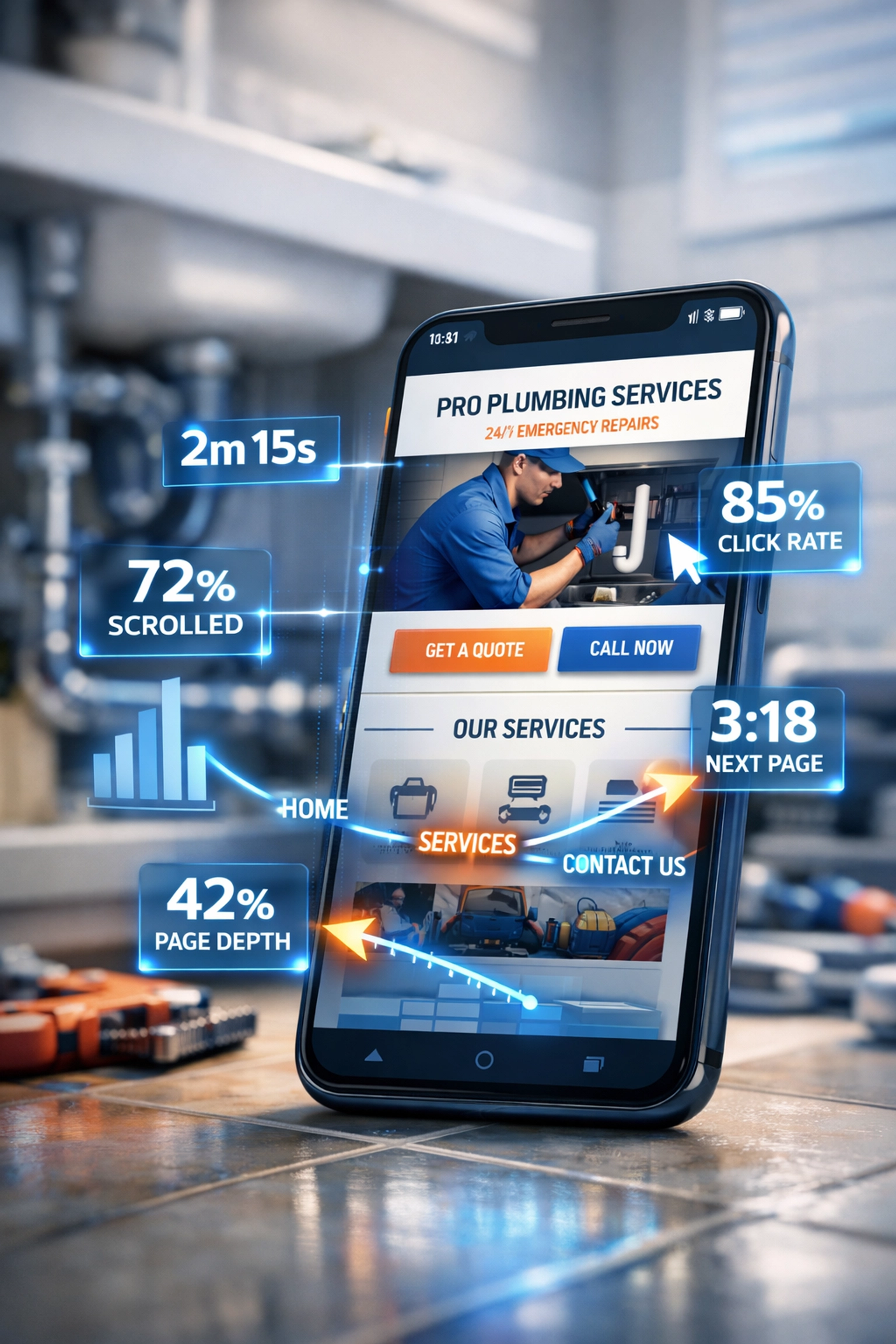
Navboost is Google's secret weapon. It tracks how users interact with your site after they click through from search results.
Google measures:
- Scroll depth: How far down the page do people read?
- Time on page: Are they skimming or actually engaged?
- Return-to-search rate: Do they bounce back to Google immediately?
If users click your link and immediately hit the back button, Google interprets that as "This result didn't help." Your rankings drop. If they scroll, click internal links, and stay engaged, Google rewards you.
The fix: Write content that actually solves the problem. No fluff. No keyword stuffing. Just the answer they came for, clearly explained in the first 200 words.
The 5 Rules Small Businesses Must Follow in 2026
1. Build Topical Authority in One Lane
Stop trying to rank for everything. Pick one core service: HVAC repair, residential plumbing, commercial electrical: and own it.
Create a hub of content around that topic:
- A cornerstone service page explaining what you do.
- Supporting blog posts answering every question your customers ask.
- Internal links connecting all related pages.
Google rewards depth over breadth. A plumber who writes 10 comprehensive guides about leak repair will outrank a general contractor who writes one article about everything.
2. Publish Like a Human Expert, Not a Content Farm
Google's December 2025 Core Update crushed sites publishing thin, AI-generated fluff. Meanwhile, businesses with real expertise saw traffic spikes.
The rule: Write consistently, not in bursts. One helpful article per month beats ten generic ones dumped in a week.
Include:
- Real photos from your jobs (not stock images).
- Specific examples from actual projects.
- Your name and credentials on every piece.
If your electrician blog sounds like it was written by a marketing intern who's never touched a wire, Google knows.
3. Optimize for Speed and Mobile
Technical performance is table stakes. If your site loads like dial-up, you're done.
The benchmarks:
- Largest Contentful Paint (LCP): Under 2.5 seconds.
- Interaction to Next Paint (INP): Under 200 milliseconds.
- Mobile-friendly design with clean navigation.
Most small business websites fail on mobile. Fix that, and you're already ahead of 60% of your competition.
4. Use Your Google Business Profile Like a Storefront
Your GBP is now your most important digital asset. It's where Entity Trust starts.
Must-dos:
- Post weekly updates (photos, offers, project highlights).
- Respond to every review within 24 hours.
- Keep your business info identical across all platforms.
- Add services, hours, and FAQs.
Google uses your GBP to verify you're a real business. Neglect it, and you're invisible in local search.
5. Answer Questions Google's AI Is Asking
SGE pulls answers from sites that directly address common questions. Structure your content around the queries your customers actually type:
- "How much does it cost to replace a water heater?"
- "What causes an electrical panel to fail?"
- "How long does a roof inspection take?"
Use those exact phrases as headers. Write clear, direct answers in the first paragraph. Add supporting details below.
This is AEO in action: optimizing for answer engines, not just search engines.
The Bafmin Approach: Consulting First, SEO Second
Most SEO consultants hand you a checklist and disappear. We do the opposite.
We start with your actual business. What's working? What's breaking? Where are you bleeding time and money?
Then we map your workflow, identify the bottlenecks, and build systems that fit your shop: not some cookie-cutter template.
SEO isn't a spreadsheet. It's a reflection of how well you understand your customers and how clearly you communicate your expertise.
If you're a three-person HVAC shop still relying on word-of-mouth, we don't push you to publish 50 blog posts. We help you document the five questions every homeowner asks you, turn those into search-optimized pages, and get Google to recognize you as the local expert.
That's the Bafmin way. Practical. Profitable. No fluff.
What Happens If You Ignore These Rules?
Your competitors won't. The businesses dominating 2026 search are the ones treating Google like a trust verification system, not a keyword slot machine.
You'll watch jobs go to shops with worse service but better Entity Trust. You'll see leads dry up as AI summaries replace your click-throughs. You'll spend more on ads to make up for lost organic visibility.
Or you can adapt.
The Opportunity for Small Businesses
Here's the good news: The new rules favor authenticity. You don't need a million-dollar backlink profile. You don't need a content team. You need clarity, credibility, and consistency.
Small businesses that focus on one topic, real expertise, and helpful content can outrank national brands. Google's algorithm rewards specificity. A local roofer who writes the definitive guide to shingle replacement in their region beats a generic contractor website every time.
The playing field is more level than it's been in a decade. But only if you play by the new rules.
Ready to stop losing clicks to AI summaries? Let's build your Entity Trust and get Google to recognize what your customers already know: you're the expert. Visit us at bafmin.com/contact to start the conversation.
No jargon. No fluff. Just results.