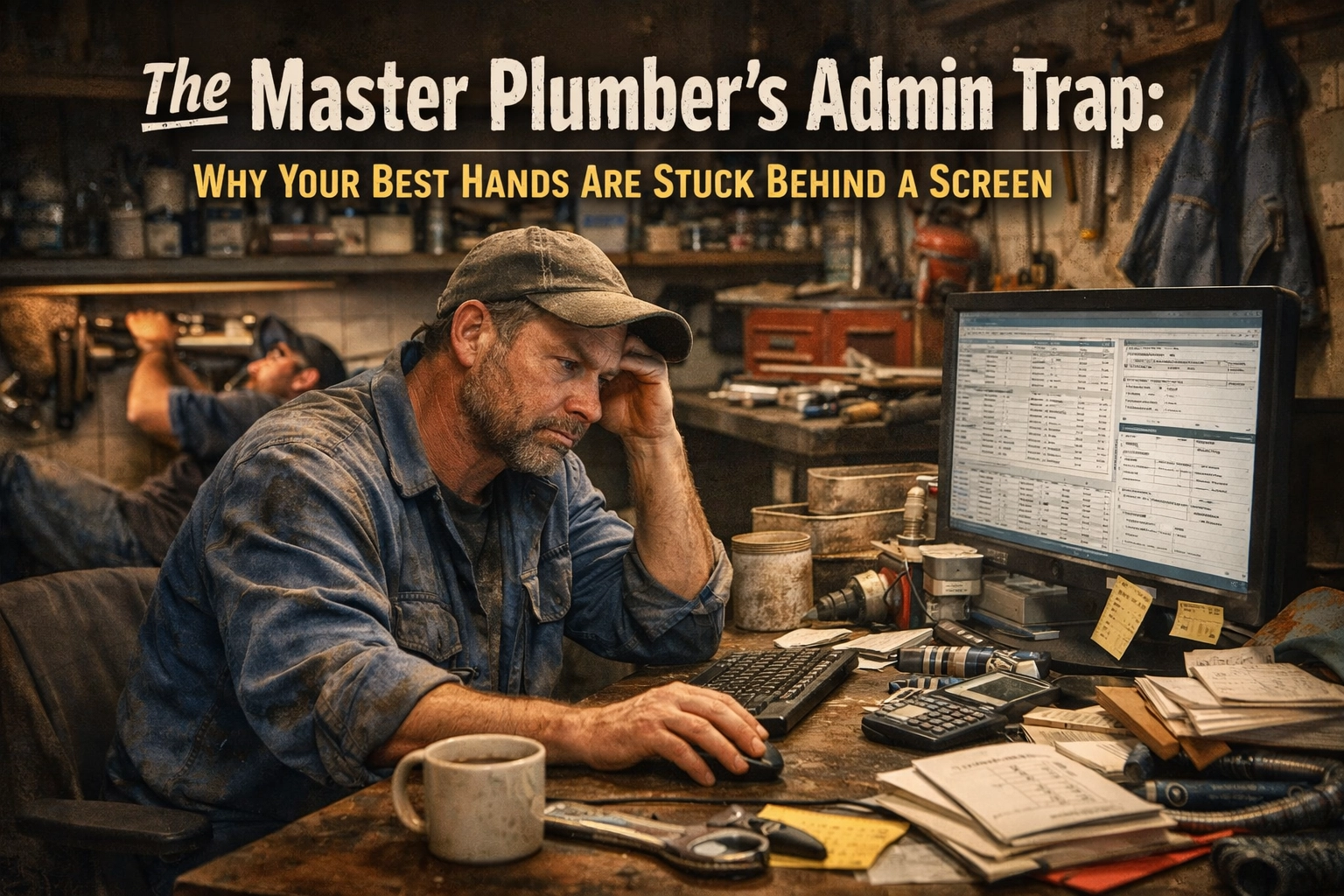
The Master Plumber's Admin Trap: Why Your Best Hands Are Stuck Behind a Screen
You're a skilled plumber. Your value is in the field. But the admin keeps creeping in anyway.
Joe has been a master plumber for twenty-three years. He can diagnose a failing pressure regulator by sound alone, retrofit a commercial kitchen in half the time of his competitors, and train apprentices who actually stick around. His hands are his best asset—steady, fast, and worth every dollar of his master rate.
So why does he spend fourteen hours a week doing office work and staring at a computer screen?
If you run a plumbing business, an HVAC company, or any skilled trade operation, you know exactly what Joe's dealing with. The work you trained for, the stuff that actually makes money, gets squeezed out by office work—scheduling calls, chasing invoices, hunting down permits, and answering the same customer questions for the hundredth time.
You didn't get your master license to do admin. But somewhere along the way, that's exactly what happened.
The Admin Trap Nobody Talks About
Here's the dirty secret about running a successful trade business: the better you get at the work, the more office work lands on your plate.
You start out turning wrenches. You get good. You get your license. You hire a couple of guys. Then suddenly you're the one doing the office work—coordinating schedules, creating estimates, following up on unpaid invoices, and tracking down that one permit that's holding up a commercial job.

The numbers don't lie. The average tradesperson spends fourteen hours per week on administrative tasks. That's over two hundred hours a year of non-billable office work. Information hunting alone—tracking down job details, finding old quotes, locating supplier invoices—eats up three to four hours every single week.
Meanwhile, your billable rate is sitting idle. Your skills are gathering dust while you're doing office work and updating a spreadsheet.
The real kicker? Every time you switch from technical work to office work, it takes approximately twenty-three minutes to regain full productivity. You're not just losing time on paperwork—you're losing momentum on everything else.
Why Evening Office Work Is Costing You Money
Most plumbers, electricians, and trade business owners do their office work in the evening. After the last job wraps, after the truck is unloaded, after dinner—that's when you finally sit down to knock out the invoices, update the schedule, and send those follow-up emails.
It makes sense. The day is done, the phone has stopped ringing, and you can finally focus.
But here's what the data shows: evening office work is thirty-five percent more likely to contain errors that require costly corrections later. You're tired. Your brain is fried from a full day of problem-solving. That's when you miss the billable extras on an invoice or fat-finger a decimal on a quote.
The average small plumbing business loses eight to twelve percent of potential profit from quote inaccuracies and forgotten billable items alone. That's not chump change. For a business doing half a million in revenue, that's forty to sixty thousand dollars walking out the door every year.
The Four Biggest Office-Work Time Sinks
Four administrative processes account for nearly eighty percent of your paperwork time:
- Estimate creation – Writing up quotes, calculating materials, accounting for labor
- Job scheduling – Coordinating availability, managing conflicts, communicating changes
- Invoicing – Itemizing work, tracking payments, following up on late accounts
- Client communication – Answering questions, sending updates, handling complaints
These tasks require immediate attention. They're urgent. But they don't require a master plumber's expertise. They don't leverage your technical knowledge, your years of experience, or your ability to solve complex installation challenges.
Yet without systems in place, you end up doing all of this office work yourself.

Old Way vs. New Way: Offloading Office Work Without Losing Control
Let's talk about what actually changes when you bring autonomous business process optimization into your operation.
Old Way: A customer calls asking for a quote on a bathroom remodel. You take notes during the call, promise to email an estimate by end of day, then spend ninety minutes that evening pulling together pricing, calculating labor hours, and formatting everything into a professional-looking document. If they don't respond in three days, you need to remember to follow up manually.
New Way: The customer calls. An AI agent captures the project details during the initial conversation, cross-references your current material costs and labor rates, generates a detailed estimate within minutes, and sends it automatically. If the customer doesn't respond, the agent follows up at optimal intervals based on conversion data. You review and approve, but you didn't spend ninety minutes building it from scratch.
Old Way: Your scheduler gets complicated. Two jobs run long, a parts delivery gets delayed, and now you have three angry customers wondering where you are. You spend an hour on the phone apologizing, rescheduling, and updating your calendar manually.
New Way: An autonomous scheduling agent monitors job progress in real-time, detects delays, automatically notifies affected customers with revised ETAs, and proposes reschedule options based on your availability. You approve the changes with a tap. Your customers get proactive communication instead of radio silence.
Old Way: Invoices pile up because you're too busy working to bill the work. By the time you catch up on paperwork, you're thirty days behind on collections, and your cash flow looks like a roller coaster.
New Way: An AI agent generates invoices immediately after job completion, sends them automatically with payment links, and follows up on outstanding balances at strategic intervals. You see a real-time dashboard of receivables without digging through spreadsheets.
This is not about replacing your judgment. It's about delegating the repetitive decision-making that bogs down your day.
What AI for Small Business Actually Looks Like
The phrase "AI for small business" gets thrown around like confetti. Most of what's marketed as AI is just slightly smarter automation—glorified if-then scripts that break the moment something unexpected happens.
Agentic AI is different. It pursues goals, adapts to changing conditions, and improves based on outcomes.

Think of it this way: traditional automation is a checklist. Agentic AI is a competent assistant who understands the goal and figures out how to get there even when conditions change.
For a plumbing business, that means:
- Lead qualification that adapts – Not every lead is equal. An agent can prioritize based on job size, location, customer history, and likelihood to convert, ensuring your best leads get attention first.
- Dynamic scheduling that reacts – When a job runs long or a part doesn't show up, the system doesn't just break. It proposes solutions, communicates with customers, and keeps operations moving.
- Compliance tracking that doesn't sleep – Permits, licenses, insurance certificates—these expire. An agent monitors deadlines and flags renewals before they become emergencies.
- Customer communication that feels human – Follow-ups, appointment confirmations, payment reminders—all handled with the right tone at the right time, without you drafting every single message.
The key is this: you stay in control. You set the parameters. You approve the big decisions. But you're not manually executing every single step anymore.
Getting Your Time Back Without Losing Control
If you're like most trade business owners, you're skeptical. You've been burned by software that promised to simplify your life but ended up creating more work. You've paid for systems that required constant babysitting.
Fair enough.
The difference with autonomous business process optimization is that the system is designed to work independently within boundaries you define. You're not building workflows from scratch or troubleshooting integrations every time something changes.
Start with the highest-impact, most repetitive tasks:
- What administrative work do you do every single day that follows a pattern?
- Where do things fall through the cracks when you're slammed with jobs?
- What decisions could someone else make if they had the right information?
Those are your prime candidates. You don't need to overhaul everything overnight. You start with one process—maybe lead follow-up or invoice generation—and let the agent prove itself.
Once you see fourteen hours a week get compressed down to two, you'll wonder why you waited.
The Bottom Line
You became a master plumber to solve complex problems, mentor the next generation, and build a business that provides for your family. You didn't sign up to get stuck doing office work and only occasionally do plumbing.
The gap is widening between trade businesses that operate autonomously and those still drowning in manual admin. The ones thriving in 2026 aren't the ones with the most tools—they're the ones that freed their best people to focus on high-value work.
Your hands are your business's most valuable asset. It's time to get them out from behind a screen.
If you're ready to explore what autonomous business process optimization looks like for your trade operation, Bafmin specializes in translating AI automation solutions into practical systems that work for plumbing, HVAC, electrical, and skilled trade businesses. We get it—because we build for the people who actually turn wrenches, not just the people who talk about it.