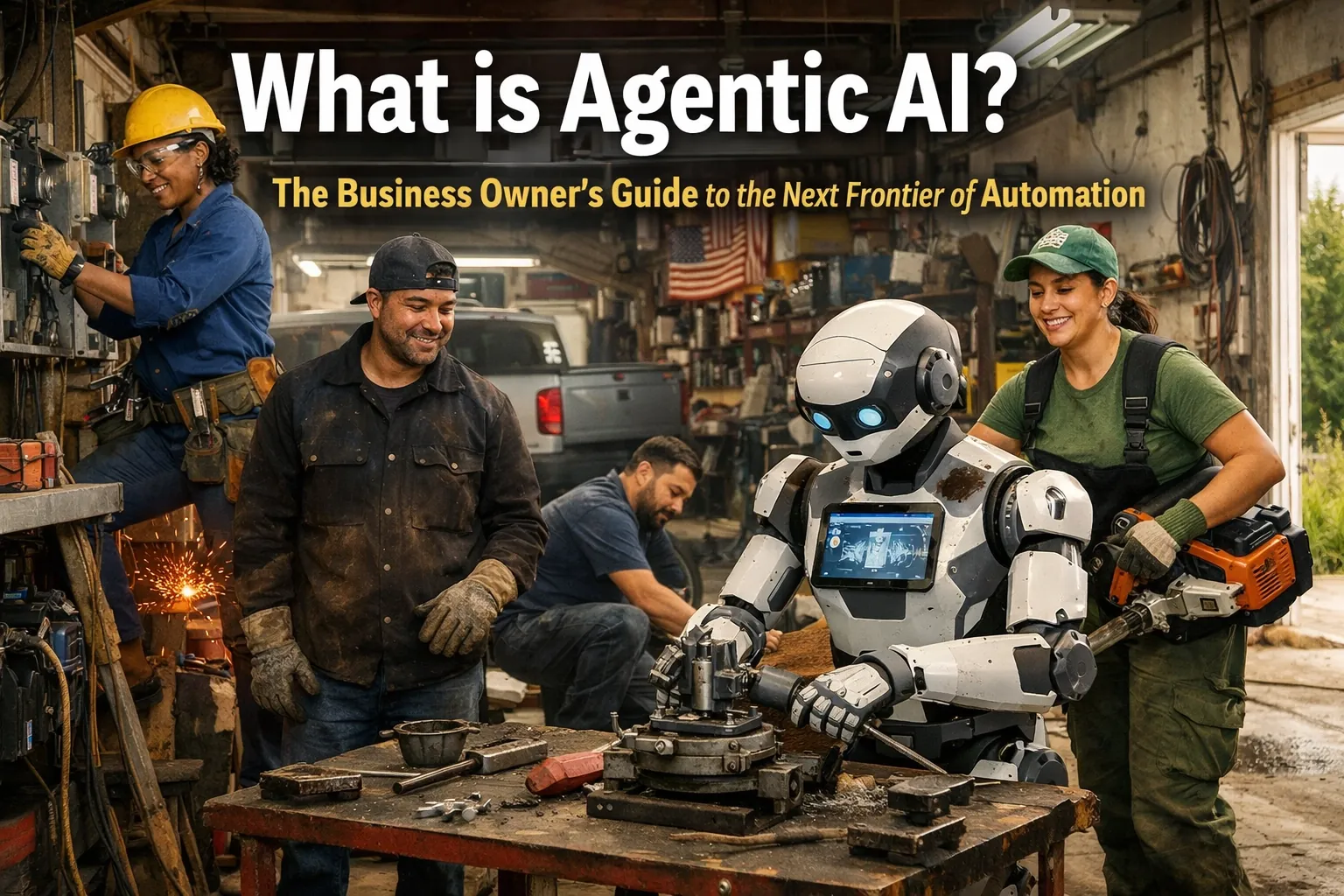
Agentic AI is an autonomous artificial intelligence system that independently plans, executes, and adapts actions to achieve complex business goals with minimal human intervention. Unlike traditional automation that follows fixed rules, agentic AI reasons through problems, navigates multi-step workflows, and makes real-time decisions to optimize business processes and drive growth.
The noise around Artificial Intelligence has reached a fever pitch. If you are a business owner in the trades, manufacturing, or healthcare sectors, you've likely been bombarded with promises about how "AI will change everything."
But the reality is that most business owners have been underwhelmed. You might have tried ChatGPT to write an email or used a basic chatbot on your website, only to find it required more "babysitting" than it saved in time.
The reason is simple: you've been using Generative AI, not Agentic AI.
The game has changed. We are moving away from AI that simply predicts the next word in a sentence toward autonomous business process optimization. The good news is that this technology has matured, and the stakes for your competitors are higher than ever.
The Technical Leap: Generative vs. Agentic
To understand why this matters for your bottom line, you have to understand the difference between a "Chatbot" and an "Agent."
Generative AI (The Writer): This is your standard LLM (Large Language Model). It's excellent at summarizing documents or drafting a text message. However, it is passive. It waits for you to tell it what to do, and it can only operate within the confines of its chat window.
Agentic AI (The Doer): An agent is goal-oriented. When you give an agent a goal, such as "Increase our lead conversion rate for HVAC installs in Tampa", it doesn't just write a plan. It executes it. It perceives the data in your CRM, reasons through which leads are most likely to convert, executes an outreach sequence, and adapts its strategy based on the responses it receives.

The Core Loop of an AI Agent
Agentic systems operate on a continuous loop that mimics human decision-making:
- Perceive: The agent gathers data from your email, your calendar, and your project management software.
- Reason: It uses logic to break a high-level goal into smaller, actionable tasks.
- Execute: It takes action, sending an invoice, booking a technician, or ordering parts.
- Adapt: If a technician is running late or a part is out of stock, the agent recalculates the plan in real-time.
Old Way vs. New Way: Why It Matters for Your Business
If you're running a plumbing shop, a machine shop, or a medical clinic, your biggest cost is "back-office friction." This is the invisible tax you pay for human error, missed follow-ups, and manual data entry.
| Feature | The Old Way (Standard Automation) | The New Way (Agentic AI) |
|---|---|---|
| Logic | "If This, Then That" (Rigid rules) | Goal-Based Reasoning (Flexible) |
| Integration | Requires custom APIs for every move | Navigates software like a human user |
| Problem Solving | Breaks when something unexpected happens | Self-corrects and finds alternative paths |
| Oversight | Requires constant manual triggers | Operates autonomously in the background |
For instance, consider your "Speed to Lead." In the old way, a lead hits your site, an automated email goes out, and then... nothing. You wait for a human to call. In the new way, an autonomous AI agent qualifies the lead, checks your actual field GPS locations, and offers a specific 15-minute window for a quote, all within sixty seconds of the initial inquiry.
The 5-Step Framework for Agentic Implementation
At Bafmin, we don't believe in "tech for tech's sake." We believe in ROI. To move your business toward autonomous operations, follow this high-authority framework:
1. Identify the "High-Friction" Goal
Don't automate "everything." Pick one specific, measurable outcome. Common starting points include:
- Reducing the time from "Quote Request" to "Contract Signed."
- Automating the collection of outstanding invoices.
- Pre-auditing patient records for compliance.
2. Map the Data Ecosystem
Agentic AI is only as good as the information it can "see." You must identify where your data lives, is it in ServiceTitan, QuickBooks, HubSpot, or a stack of paper invoices? For an agent to be effective, it needs a digital map of your operations.
3. Define the Guardrails
Autonomous does not mean "uncontrolled." High-impact agentic systems require strict security and trust protocols. You define the limits: the agent can book appointments, but it cannot offer a discount higher than 10% without your approval.
4. Connect the Action Layer
This is where the agent moves from thinking to doing. Using AI automations, we connect the reasoning engine to your tools. This allows the agent to actually "click" the buttons in your software, send the texts, and move the files.
5. Monitor, Refine, and Scale
Once the agent is live, it provides a feedback loop. You'll see exactly where it's succeeding and where it needs more information. As the agent gets "smarter" with your specific business data, you can expand its responsibilities from one department to the entire company.

Why Small Businesses Must Act Now
The "early adopter" phase of AI is over. We are now in the "implementation" phase. Large-scale competitors are already building agentic layers to hollow out their administrative costs. If your competitors can operate with 30% lower overhead because they've replaced manual scheduling with autonomous agents, they can outbid you every single time.
This isn't just about efficiency; it's about survival. The reality is that AI Copilots are dead; long live the Agents. You don't need another tool that sits on your sidebar and gives you suggestions. You need an agent that handles the "grunt work" so you can focus on the "craft work."
Frequently Asked Questions (AEO/FAQ)
Is Agentic AI the same as a chatbot?
No. A chatbot is designed to talk; an agent is designed to act. While you can communicate with an agent via a chat interface, its primary function is to execute multi-step tasks across different software systems to achieve a specific goal.
How much does autonomous business process optimization cost?
The cost varies based on complexity, but for most SMBs and trades, the investment is a fraction of the cost of a full-time administrative hire. The goal is always to achieve a net-positive ROI within the first 90 days.
Is my data safe with AI agents?
Security is the primary concern for any agentic system. At Bafmin, we utilize enterprise-grade encryption and private data silos to ensure that your business intelligence is never used to train public models.
Can an AI agent really handle trades-specific tasks?
Yes. From managing complex "Speed to Lead" requirements in HVAC to conducting healthcare audits, agentic AI is uniquely suited for industries that rely on logistics, scheduling, and compliance.
The Bottom Line
Agentic AI is the most significant shift in business technology since the invention of the internet. It represents a move away from "software as a tool" toward "software as a teammate."
The complexity of your business: the missed calls, the messy billing, the "admin trap": is exactly what these systems are designed to solve. The transition isn't an overnight flip of a switch; it's a strategic move toward becoming an autonomous entity.
If you are ready to stop "managing" your software and start letting it work for you, it's time to look at what agentic solutions can do for your specific shop or clinic.
Ready to see where the fat is in your current operations? Start with a Reality Audit or contact us today to discuss building your first autonomous agent.